10 min read
If you operate or manage a car wash facility, you know that the right chemistry is everything. Your chemicals are the backbone of your operation—they determine water spot prevention, wash quality, efficiency, and ultimately, customer satisfaction. Yet many car wash operators remain somewhat in the dark about what's actually happening when different chemical products hit the surface of a vehicle.
This guide will demystify car wash chemistry, walk you through the major categories of chemicals you'll encounter, and help you make informed decisions about which products make sense for your operation.
Understanding the Basics: What Are Car Wash Chemicals?
Car wash chemicals are specially formulated solutions designed to clean, protect, and enhance vehicle surfaces safely and efficiently. They work by using the principles of chemistry to break down soil, suspend particles, and prevent them from re-depositing on the vehicle.
At the core of most car wash chemicals are surfactants—compounds that reduce the surface tension of water. Think of surfactants as molecules with two opposing personalities: one end loves water, while the other end loves oil. This dual nature allows them to surround oil and grease particles, lifting them away from the surface so they can be rinsed away with water.
Different car wash chemicals use surfactants in different concentrations and with different additives to achieve specific results. Understanding these categories will help you stock your facility with the right tools for every cleaning challenge.
The Major Categories of Car Wash Chemicals
Pre-Soak and Pre-Wash Solutions
Pre-soak chemicals are typically the first step in a multi-stage wash process. They're designed to loosen and begin breaking down heavy soils like road grime, mud, salt residue, and tar before the main wash cycle begins.
Pre-soak solutions are usually applied as a foam or spray and given time to dwell on the vehicle surface—anywhere from 30 seconds to several minutes depending on soil level. This dwell time is critical: it allows the chemistry to penetrate dried soils and begin the breakdown process.
When to use pre-soaks:
In high-traffic markets where vehicles encounter significant road salt
During winter months when road treatment chemicals accumulate
For vehicles with visible mud or heavy soil buildup
In arid climates where dust and hard soils are common
Car Wash Shampoos
The main wash chemistry is typically a shampoo formula—often called a "car wash soap," though it's not actually soap in the traditional sense. Car wash shampoos contain surfactants optimized for general-purpose cleaning while maintaining appropriate pH levels to be safe on paint and clear coat.
Quality car wash shampoos deliver several benefits simultaneously:
They lift and suspend soil particles
They create sufficient lubricity so wash mitts and brushes glide across the surface without scratching
They rinse cleanly without leaving residue or water spots
They often contain additives that enhance shine or provide water beading
Different formulations vary in strength. Some are concentrate-based and require dilution, while others come pre-diluted. The concentration impacts your cost per vehicle and your environmental footprint.
Key consideration: The dilution ratio directly affects both cost and wash quality. Higher concentrations may reduce your per-vehicle cost but require precise measuring to avoid waste or poor results.
Triple Foam and Color Enhancing Chemicals
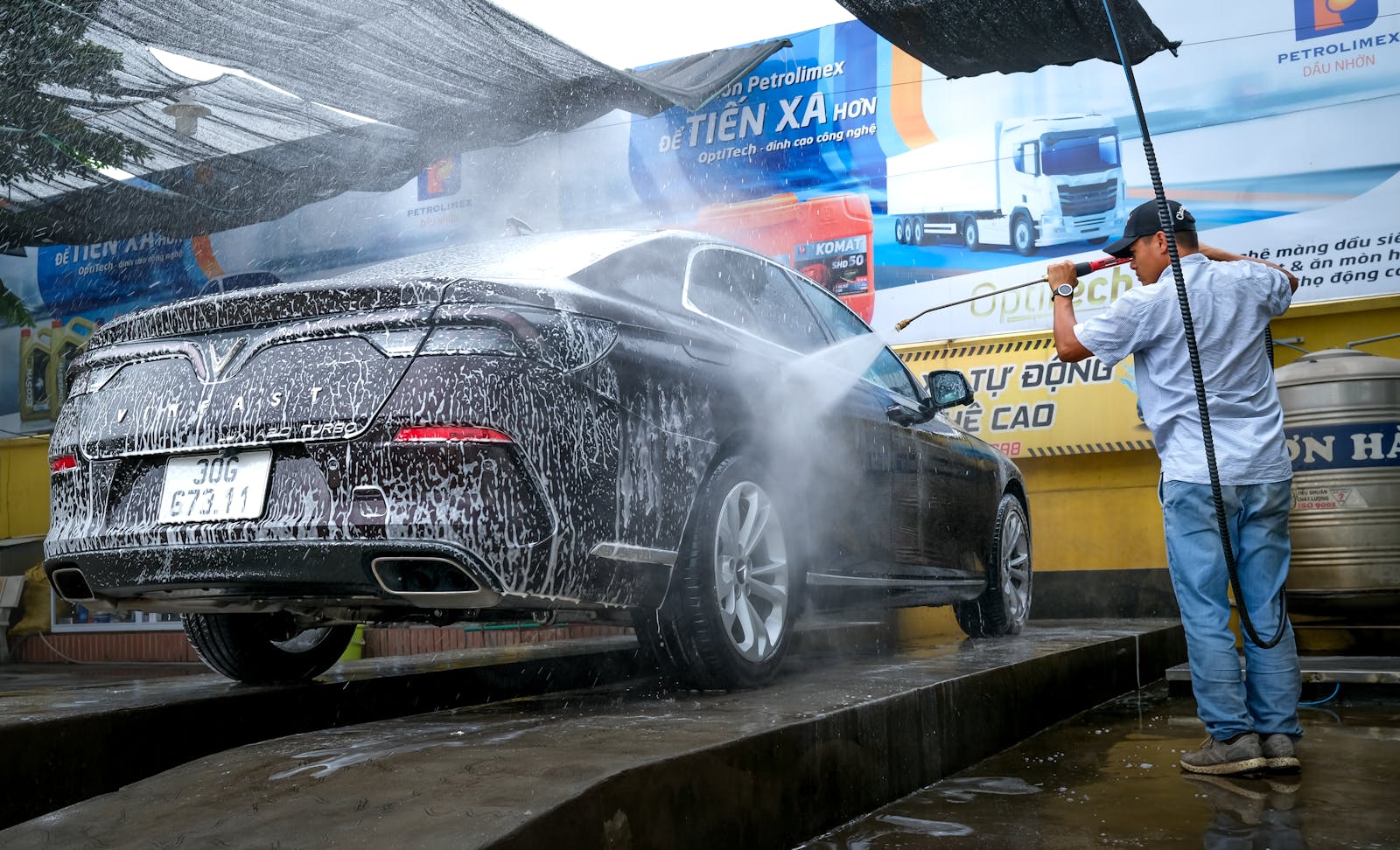
Triple foam products—also called foam washes—are designed to apply a thick, clinging foam to the vehicle surface. This foam serves multiple purposes:
It visibly shows customers their vehicle is being cleaned (the "perception of cleaning" is real)
It adds lubricity to protect the paint during contact washing
Some formulations contain optical brighteners or color enhancers that make paint appear glossier and more vibrant
These products are often applied in a separate stage after initial washing, either as the main wash chemistry or as a secondary application. The color-enhancing variants are particularly popular with premium wash packages because customers immediately notice the enhanced appearance.
Wheel and Tire Cleaners
Wheels and tires accumulate brake dust, road tar, and salt—soils that regular car wash shampoo doesn't address effectively. Wheel and tire cleaners are specially formulated to break down these specific contaminants without damaging the wheel finish.
Most wheel cleaners contain chelating agents or modified surfactants that target brake dust and mineral deposits while being gentle on alloy wheels, painted surfaces, and tire sidewalls. Some are designed for one type of wheel (chrome, painted alloy, steel), while others are versatile enough for all surfaces.
Critical consideration: Not all wheel cleaners are created equal. Some are too aggressive and can damage certain finishes, while others aren't strong enough for heavy brake dust. Matching the right formula to your typical clientele matters.
Drying Agents and Spot-Prevention Chemistry
Water spotting is one of the most common customer complaints at car washes. Hard water minerals leave visible spots when water is allowed to dry naturally on painted surfaces. Drying agents address this through two mechanisms:
Modified water chemistry that prevents mineral precipitation
Surfactants that promote sheeting so water runs off in sheets rather than beading up in droplets
Quality drying agents contain chelating agents that bind to minerals before they can crystallize on the surface. When properly applied, they virtually eliminate water spotting even in areas with very hard water.
These are typically applied in a final rinse stage or as a separate application after the main wash. The cost-per-vehicle for an effective drying agent is modest, but the impact on customer satisfaction is significant.
Bug and Tar Removers
Certain soils—particularly bug splatter, tree sap, and road tar—require chemistry stronger than regular shampoo. These specialty removers use solvents or modified surfactants designed to penetrate and break down these stubborn contaminants.
Bug and tar removers are usually applied as spot treatments rather than full-vehicle applications, since their stronger formulations can be harsh if used everywhere. They're essential for customers who drive highway miles or park under trees.
Sealants and Protective Coatings
Beyond cleaning, many car wash operators offer protective chemistry that beads water, reduces future soil adhesion, and enhances shine. These range from simple carnauba-based sealants to synthetic polymer coatings designed to last through multiple washes.
Protective products are typically premium add-ons that increase revenue per wash while delivering genuine customer value. They improve the vehicle's appearance between washes and reduce the effort required to keep vehicles clean.
How Car Wash Chemicals Actually Work: A Closer Look
Understanding the mechanisms behind car wash chemistry helps you troubleshoot issues and choose the right products for your operation.
Surfactant action: When a surfactant molecule contacts an oil-based soil, its water-loving end stays oriented toward the water, while its oil-loving end embeds in the soil. As more surfactant molecules surround the soil particle, it becomes encapsulated—suspended in water where it can be rinsed away.
pH considerations: Most car wash chemistry is formulated to be pH-neutral or slightly alkaline, avoiding the corrosive extremes that could damage paint or metalwork. However, different surfaces benefit from different pH levels, which is why alkaline pre-soaks work well for heavy soil while neutral shampoos work better for the main wash.
Dwell time: Many car wash chemicals require adequate contact time with the soil to work effectively. This is why presoak chemicals are applied and left to work for several minutes—the chemistry needs time to penetrate and break down the bonds holding soil to the surface.
Choosing the Right Chemicals for Your Operation
Several factors should influence your chemical selection:
Water Conditions
Hard water (high mineral content) requires different chemistry than soft water. Hard water can reduce the effectiveness of surfactants and makes water spotting more likely. If your facility operates in a hard water area, your drying agents and final rinse chemistry become even more critical.
Some water treatment solutions—like water softening or deionized rinse systems—can reduce chemical demands, though they add equipment cost.
Climate and Seasonal Variations
Winter operations in cold climates face unique challenges. Road salt, sand, and treatment chemicals accumulate heavily on vehicles. Your pre-soak and main wash formulations may need to be more aggressive during winter months.
Conversely, arid climates see more dust and dried soils, which may require different surfactant profiles than wet climates with different soil types.
Equipment Compatibility
Not all chemicals work well with all equipment. Some are formulated to foam extensively (good for foam brushes and foam cannons), while others are designed to minimize foam (better for mechanical brush systems). Your chemical supplier should understand your equipment configuration and recommend compatible products.
Dilution Ratios and Operating Costs
A concentrate chemical that requires 10-to-1 dilution is fundamentally cheaper per vehicle than a pre-diluted product, but it demands precise measurement and quality control to ensure consistency. Your staff's ability to handle dilution accurately impacts both cost-efficiency and wash quality.
Building Customer Value
Beyond basic cleaning, consider what your target market values. Premium customers may appreciate tire shine and protective coatings. Fleet operators may prioritize consistency and cost-efficiency. Understanding your customer base helps you select a chemical program that aligns with their expectations.
The Relationship Between Chemistry and Equipment
Chemistry and equipment work together. Your wash system's delivery method—whether it's foam cannons, brush applicators, or pressure systems—influences which chemical formulations will work best. A chemistry optimized for misting may perform poorly in a high-pressure system, and vice versa.
A knowledgeable chemical supplier understands this relationship and can recommend formulations specifically engineered for your equipment. This alignment is one of the most underappreciated factors in achieving consistent, high-quality results.
Common Mistakes in Chemical Selection
Assuming all products in a category are identical: They're not. Pre-soaks vary widely in strength and effectiveness. Drying agents range from basic to sophisticated. Price differences often reflect genuine differences in formulation and performance.
Prioritizing cost over results: Cheap chemistry can damage your brand faster than expensive chemistry can build it. A customer who gets a poor wash from weak formulations is more likely to complain and switch facilities than to appreciate the low price.
Ignoring water conditions: Using the same chemistry in every market regardless of water hardness, mineral content, or pH is a recipe for inconsistent results. Water conditions matter tremendously.
Overlooking compatibility: Installing a new chemistry system without verifying equipment compatibility can result in poor foam, inadequate cleaning, or equipment damage.
Neglecting staff training: Even the best chemistry requires proper application. Your team needs to understand dilution ratios, application rates, dwell times, and sequence to achieve consistent results.
Partnering with Your Chemical Supplier
The right chemical supplier is more than just a vendor—they're a partner in your operation's success. They should:
Understand your specific equipment configuration
Provide training to your staff on proper use
Help you troubleshoot quality issues
Recommend adjustments based on seasonal changes and water conditions
Offer consistency in product formulations
Support your business goals with products that enhance your margins
Look for suppliers who take time to understand your operation before recommending a chemistry program, rather than pushing a standardized package.
Conclusion
Car wash chemistry is both art and science. While the underlying chemistry is complex, understanding the major categories of products, how they work, and what to look for in quality formulations will make you a more informed operator.
The best car wash programs aren't one-size-fits-all—they're customized to your water conditions, climate, equipment, market position, and customer expectations. By selecting chemistry strategically and partnering with a knowledgeable supplier, you'll optimize wash quality, operational efficiency, and customer satisfaction.
Ready to evaluate your current chemistry program or explore a custom formulation that's optimized for your specific operation? Contact our team with details about your facility, and our chemistry experts will work with you to design a program that delivers results.
Related Reading
Ready to get started? Request a quote to discuss your project with our team, or contact us to learn more about our capabilities.