Mar 3, 2026
10 min read
If You Sell, Ship, or Handle Chemical Products, GHS Labeling Is Not Optional
The Globally Harmonized System of Classification and Labelling of Chemicals (GHS) is the international standard that dictates how chemical hazards are communicated on product labels and Safety Data Sheets. In the United States, OSHA adopted GHS through its revised Hazard Communication Standard (HazCom 2012), making compliance a legal requirement for every chemical manufacturer, importer, distributor, and employer.
Whether you manufacture your own products, private label through a contract manufacturer, or purchase chemicals for your facility, understanding GHS labeling is essential. Non-compliant labels can result in OSHA citations, fines starting at $16,131 per violation (and up to $161,323 for willful violations as of 2025), product recalls, and — most importantly — preventable workplace injuries.
This guide breaks down the six required elements of a GHS-compliant label, explains the classification system, and provides practical guidance for getting your labels right.
The Six Required Elements of a GHS Label
Every chemical product that presents a physical or health hazard must carry a label with these six elements:
1. Product Identifier
The product identifier is the name or number used to identify the hazardous chemical. This must match the product identifier used on the corresponding Safety Data Sheet (SDS). It can be a chemical name, a code number, or a batch number — but it must be consistent and traceable.
For private label products, this is typically the brand name and product name your company assigns. The key requirement is that anyone who reads the label can match it to the correct SDS.
2. Signal Word
The signal word indicates the relative severity of the hazard. There are only two options:
DANGER — Used for more severe hazard categories
WARNING — Used for less severe hazard categories
A product can only have one signal word. If multiple hazards are present, the label uses the signal word associated with the most severe hazard. You never use both on the same label.
3. Hazard Statements
Hazard statements are standardized phrases that describe the nature of the hazard. They are assigned based on the hazard classification and must be used exactly as written — you cannot paraphrase or substitute your own wording.
Examples include:
"Causes severe skin burns and eye damage" (H314)
"Harmful if swallowed" (H302)
"Highly flammable liquid and vapor" (H225)
"May cause respiratory irritation" (H335)
"Causes serious eye irritation" (H319)
Each hazard statement has an H-code (H followed by three digits). While the H-codes are not required on the label itself in the US, they are useful for cross-referencing with SDS documentation and international requirements.
4. Pictograms
GHS pictograms are standardized symbols enclosed in a red diamond border that visually communicate hazard types. There are nine pictograms in the GHS system:
Pictogram | Hazard Type | Common Products |
|---|---|---|
Flame | Flammable liquids, aerosols, gases | Solvents, aerosol cleaners, alcohols |
Flame over circle | Oxidizers | Peroxide-based cleaners, bleach concentrates |
Exploding bomb | Explosives, self-reactive | Rarely applicable to cleaning chemicals |
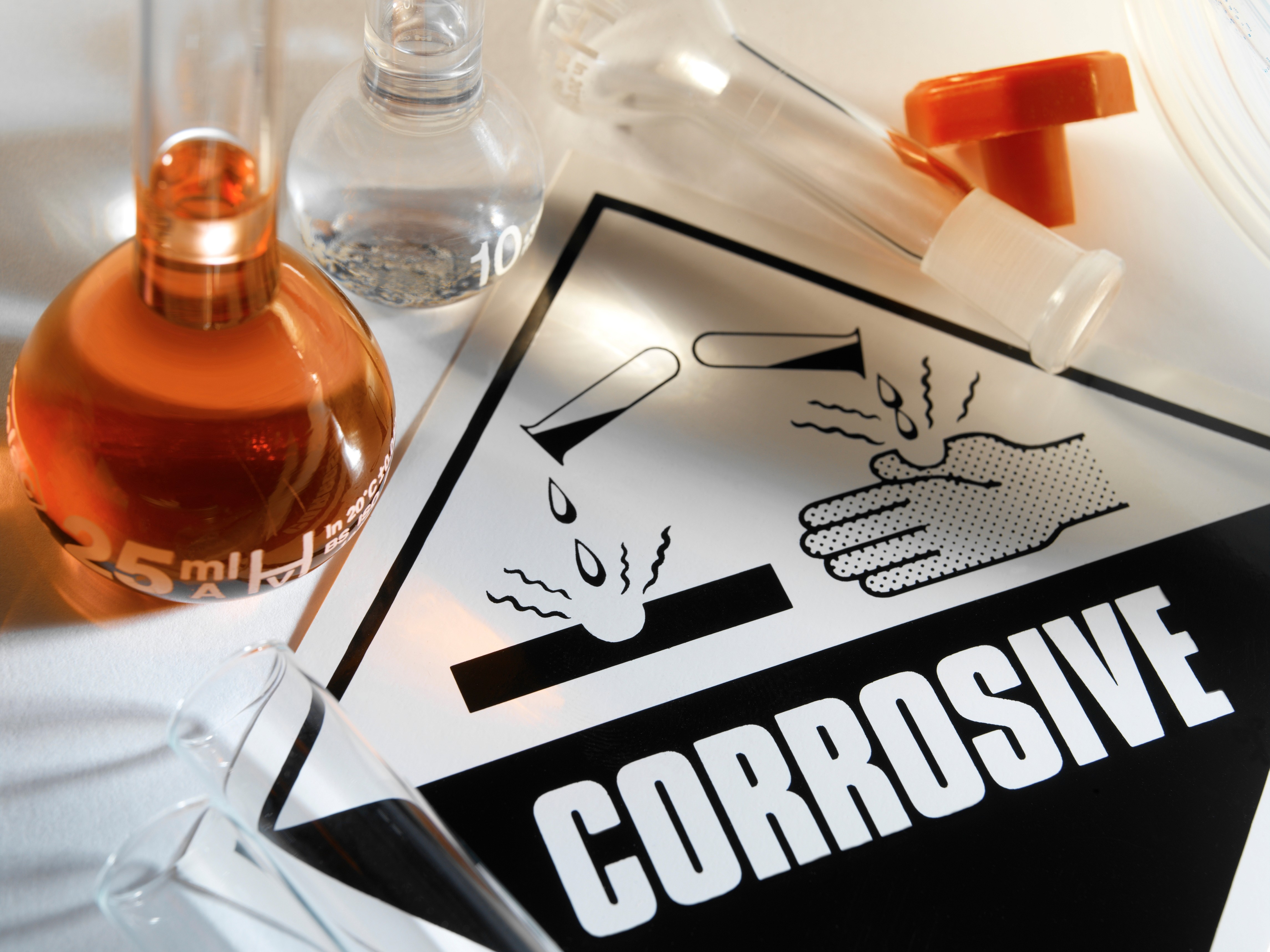
Corrosion | Corrosive to metals, skin, eyes | Acid cleaners, caustic degreasers, drain openers |
Skull and crossbones | Acute toxicity (fatal or toxic) | Concentrated pesticides, certain industrial chemicals |
Exclamation mark | Irritant, skin sensitizer, narcotic | General purpose cleaners, mild acids |
Health hazard | Carcinogen, organ toxicity, mutagenicity | Certain solvents, some industrial chemicals |
Gas cylinder | Compressed gases | Aerosol products, gas cylinders |
Environment | Aquatic toxicity | Products toxic to aquatic organisms |
The environmental pictogram is not required under OSHA HazCom but is required under EPA and DOT regulations in certain contexts, and is mandatory in many international markets.
5. Precautionary Statements
Precautionary statements provide recommendations for minimizing or preventing adverse effects from exposure, storage, handling, and disposal. They are organized into four categories:
Prevention — How to minimize exposure ("Wear protective gloves/eye protection")
Response — What to do if exposure occurs ("IF IN EYES: Rinse cautiously with water for several minutes")
Storage — How to store safely ("Store in a well-ventilated place. Keep cool.")
Disposal — How to dispose properly ("Dispose of contents/container in accordance with local regulations")
Like hazard statements, precautionary statements have standardized codes (P-codes) and must be used as written. The specific statements required depend on the hazard classification.
6. Supplier Information
The label must include the name, address, and phone number of the chemical manufacturer, importer, or other responsible party. For private label products, this is typically the brand owner — not the contract manufacturer — unless otherwise agreed upon.
How GHS Classification Works
Before you can create a compliant label, you need to classify your product. GHS classification determines which hazard statements, pictograms, signal words, and precautionary statements apply.
Classification is based on the product's physical, health, and environmental hazard properties:
Physical hazards include flammability, oxidizing properties, corrosivity to metals, compressed gases, and reactivity. These are determined by standardized physical testing (flash point, pH, oxidizing potential, etc.).
Health hazards include acute toxicity (oral, dermal, inhalation), skin corrosion and irritation, eye damage and irritation, respiratory and skin sensitization, carcinogenicity, reproductive toxicity, organ toxicity, and aspiration hazard. These are determined by toxicological data, either from testing or from published data on individual ingredients.
Environmental hazards include acute and chronic aquatic toxicity. These are determined by ecotoxicological data.
For most cleaning chemical products, classification can be performed using the mixture calculation rules in the GHS framework. If you know the hazard classifications of each ingredient and their concentrations in the mixture, you can calculate the classification of the finished product using established formulas and concentration cutoffs.
Common GHS Labeling Mistakes
Using Outdated Hazard Communication
The old OSHA HazCom standard used orange warning labels with different symbols (the NFPA diamond, for instance). Some manufacturers still have products on shelves with pre-GHS labels. All workplace chemical labels must be GHS-compliant. If your products still carry the old format, they are out of compliance.
Incorrect or Missing Pictograms
Every applicable pictogram must appear on the label. A common error is omitting the corrosion pictogram on alkaline degreasers with a pH above 11.5, or omitting the exclamation mark for products that cause skin or eye irritation. The classification determines the pictograms — this is not discretionary.
Paraphrasing Hazard Statements
GHS hazard statements are standardized for a reason. Writing "May harm skin" instead of the correct "Causes skin irritation" (H315) is non-compliant. Use the exact wording from the GHS framework.
Omitting Precautionary Statements
Some manufacturers include hazard statements but skip or abbreviate precautionary statements to save label space. All required precautionary statements must appear. If label space is an issue, GHS allows the use of fold-out labels, booklet labels, or tags.
Inconsistency Between Label and SDS
The hazard information on your product label must match Section 2 of your Safety Data Sheet exactly. If the SDS says "Danger" and the label says "Warning," you have a compliance problem. Always generate labels and SDS documents from the same classification data.
GHS Labeling for Private Label and White Label Products
If you are launching a chemical product line through a contract manufacturer, GHS labeling is part of the process you need to plan for. Here is how it typically works:
The manufacturer classifies the product based on the formulation and generates the GHS hazard data. This includes the signal word, hazard statements, pictograms, and precautionary statements.
The brand owner creates the label using the GHS data provided by the manufacturer. The label must include all six required elements, with the brand owner listed as the responsible party (supplier information).
The SDS is generated to match the label. The manufacturer typically provides the SDS, either under the brand owner's name or with the manufacturer listed as the preparer.
At Sky Blue Chemical, we handle the classification and provide our private label and toll blending customers with complete GHS data packages. This includes all hazard data needed for label creation, plus SDS documents formatted to your brand specifications. You don't need a toxicologist on staff — we do this work as part of our manufacturing service.
International Considerations
If you sell chemical products outside the United States, be aware that GHS implementation varies by country. The core system is the same, but different countries have adopted different revisions and may have unique requirements:
Canada uses WHMIS 2015, which is aligned with GHS but has additional requirements including bilingual (English/French) labeling
EU uses CLP (Classification, Labelling and Packaging) regulation, which follows GHS but includes supplemental hazard statements unique to Europe
Australia, Japan, South Korea, China all have their own GHS implementations with varying adoption of hazard categories
If you export or plan to export, work with your manufacturer to ensure labels meet the requirements of each target market.
Getting Your Labels Right
GHS labeling does not have to be overwhelming. The process is methodical: classify the product, determine the required label elements from the classification, and apply them correctly. The challenge is usually in the classification itself, which requires either toxicological expertise or a knowledgeable manufacturing partner.
Here is a practical checklist for reviewing your labels:
Product identifier matches the SDS exactly
Signal word is correct for the highest severity hazard
All applicable pictograms are present with red diamond borders
Hazard statements use exact standardized wording
Precautionary statements cover prevention, response, storage, and disposal
Supplier name, address, and phone number are current
Label is legible, durable, and prominently displayed on the container
How Sky Blue Chemical Supports Your Compliance
At Sky Blue Chemical, regulatory compliance is built into every product we manufacture. When you partner with us for custom formulation, toll blending, or white label production, we provide complete GHS classification data and SDS documentation for every product.
Our team stays current on HazCom requirements, state-specific regulations, and international standards so you don't have to. Whether you need labels for a single SKU or a full product line, we give you the hazard data you need to produce compliant labels from day one.
Questions about GHS labeling for your products? Contact us or request a quote to discuss your compliance needs.